John Francis Aylard - (Ord. Signalman/Coder - RNVR) - HMS Jervis Bay
And an insight into HMS Jervis Bay and her crew itself

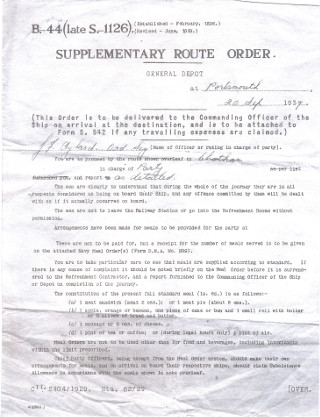
In 1939, thirty RNVR young men were sent to Portsmouth Naval Barracks (HMS Nelson) to learn the 'Naval Administrative Code Book'.
As war broke out, all signals (radio) to and from naval ships/shore bases had to be coded signals.
Hence, the need for 'Coders' on naval ships. The men were to be paid 2 shillings a day (approx. 10 pence in todays terms.)
Out of six classmates, three were chosen to join HMS Jervis Bay, an armed merchant cruiser.
The three names nearest the beginning of the alphabet were chosen, so HMS Jervis Bay ended up with coders called Abbott, Aylard and Bennett.
The next three names (two B's and a C) joined AMC Rawalpindi, and so on.
Rawalpindi was to be the first AMC sunk in 1939 (Denmark Strait), ironically taking over a duty originally intended for HMS Jervis Bay.
All of the coders on the Rawalpindi were killed.
 |
 |
|
|
John Aylard was born in Highgate, London in 1920. Brought up in Highgate & Southwark. He joined the Royal Navy Volunteer Reserve (RNVR) in May, 1939,
aged a mere 19 years of age.
After training to be a coder at Portsmouth, Hampshire, he would be assigned to the A/M/C HMS Jervis Bay.
HMS Jervis Bay (under Captain Harris), had many of the older/experienced Royal Fleet Reserve (RFR) men on board, who taught the younger RNVR lots as
regards naval and sea duties.
The men were to sleep in hammocks in various groups (known as a mess).
HMS Jervis Bay left London Docks (painted battleship grey) in September, 1939, bound for Scapa Flow in Scotland. The ship had been assigned to protect
the Denmark Straits (between Iceland & Greenland), known as the 'Northern Patrol'.
At Scapa Flow, the Jervis Bay 'lost its anchor' and drifted towards another naval ship (HMS Scimitar), which it duly sunk.
 HMS Jervis Bay had to go to Hebburn, near Newcastle Upon Tyne for repairs.
HMS Rawalpindi took over her allocated patrol duties, and was subsequently sunk. She had been targeted as a British naval destroyer. She had the misfortune
to encounter two of the German's top warships (Scharhorst & Gneisenau), and 283 men (including the 3 x assigned coders) lost their lives.
Hopelessly outgunned, only 48 men would survive the tragedy. She sank within 40 minutes.
HMS Jervis Bay had to go to Hebburn, near Newcastle Upon Tyne for repairs.
HMS Rawalpindi took over her allocated patrol duties, and was subsequently sunk. She had been targeted as a British naval destroyer. She had the misfortune
to encounter two of the German's top warships (Scharhorst & Gneisenau), and 283 men (including the 3 x assigned coders) lost their lives.
Hopelessly outgunned, only 48 men would survive the tragedy. She sank within 40 minutes.

It was after this tragic event, that Jervis
Bay was repainted in her 'house' (Aberdeen & Commonwealth Line) colours
of green hull, white superstructure and buff coloured funnel. She had (like
Rawalpindi) been painted battleship grey at Royal Albert Dock, London
originally. This was done, so that Jervis Bay would not be as visible to
the enemy as had the Rawalpindi, and so hopefully not targeted. The
paint work, undertaken at Hebburn, Tyneside, England, took place at the same
time as Jervis Bay was having repairs for the accident at Scapa Flow,
Scotland, which saved her from the fate that Rawalpindi undertook. Good
fortune bestowed HMS Jervis Bay, for the moment at least.

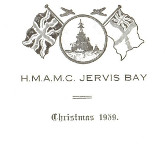
HMS Jervis Bay spent Christmas, 1939, anchored in the fog off Portsmouth Harbour in Hampshire, England.
She would proceed to Freetown, Sierra Leonne, Africa to commence the 'Africa convoys', in January, 1940.
She would protect convoys between South Africa & England, though never actually reach England herself again.
On the way to Freetown, Jervis Bay picked up supplies at Dakar ( a
French colony in what is now Senegal, North West Africa ), where the men went
ashore for a short while. Jervis Bay escorted a few convoys (SL 017F; SL023F; SL 023;
- without incident), before Captain Harris took ill, and had to leave the ship.
 Commander Blackburn took temporary command of the ship in
February, 1940. It was under his command, that Jervis Bay undertook the
longest tow in WW2. Sent to rescue a stricken freighter (Hartismere) in
the South Atlantic, under the navigating skills of navigating officer George L.
Roe, it located the Hartismere (under temporary tow by the liner 'Queen
Of Bermuda'), and took over the tow on approximately 19 February, 1940.
It took ten days to tow the stricken freighter at sitting-duck speed back to
Freetown (mentioned in 'Conclusions of a Meeting of the War Cabinet held at 10 Downing
Street, S.W. 1, on Tuesday, February 20, 1940, at 11-30 A.M. , Page 71'),
earning the congratulations of the C-in-C for retrieving the disabled
freighter. The Hartismere would later be
attacked by U-100 in
August 1940, and sunk in July 1942, by the
Japanese submarine I-10.
Commander Blackburn took temporary command of the ship in
February, 1940. It was under his command, that Jervis Bay undertook the
longest tow in WW2. Sent to rescue a stricken freighter (Hartismere) in
the South Atlantic, under the navigating skills of navigating officer George L.
Roe, it located the Hartismere (under temporary tow by the liner 'Queen
Of Bermuda'), and took over the tow on approximately 19 February, 1940.
It took ten days to tow the stricken freighter at sitting-duck speed back to
Freetown (mentioned in 'Conclusions of a Meeting of the War Cabinet held at 10 Downing
Street, S.W. 1, on Tuesday, February 20, 1940, at 11-30 A.M. , Page 71'),
earning the congratulations of the C-in-C for retrieving the disabled
freighter. The Hartismere would later be
attacked by U-100 in
August 1940, and sunk in July 1942, by the
Japanese submarine I-10.

On 17 February, 1940, whilst on route to the rescue of the SS Hartismere, the crew took part in the naval 'Crossing The Equator' ceremony.
'Crossing The Line' involves crewmen who have already crossed the Equator (known as Trusty/Shellbacks or Sons Of Neptune) and those men who have never
crossed the Equator (known as Slimy/Pollywogs or Griffins). It takes two days to complete (night and day.)
One crewman (dressed up as King Neptune) holds court, assisted by other crewmen (Trusty Shellbacks) as his assistants.
The Slimy Pollywogs are hence initiated into the Court Of Neptune, to become a Shellback themselves.
The eve of the Equatorial crossing is called 'Wog Day'.
'Wogs' (all of the uninitiated) are allowed to capture and interrogate any 'Shellbacks' that they can find.
They can tie-up Shellbacks, crack eggs/pour aftershave on their heads etc, but are warned that if they do, they can themselves expect 'harder'
treatment (when the time comes) in return.
After actually crossing the Equatorial Line, Pollywogs receive a subpoena to appear before King Neptune and his Court.
The Court includes the 1st Assistant (Davy Jones) and her Highness Amphitrite, all represented by high ranking ratings/seamen.
The Court is usually preceded by a 'beauty contest' of crewmen dressed in drag.
Each ship department has to introduce one 'woman' dressed in swimsuit drag.
Afterwards, some Wogs may be interrogated by King Neptune and his entourage, and the use of 'Truth Serum' (hot sauce and aftershave) and whole uncooked
eggs are placed in the mouth.
During the ceremony, Pollywogs encounter a number of embarrassing ordeals.
These can include wearing clothing inside out, or the wrong way around, crawling on hands and knees, being locked in stocks and pilloried or swatted with
firehose, being locked in a coffin of salt water & bright green dye, crawling through shoots of rotting rubbish, kissing the belly of the 'Royal Baby'
coated in axle grease, hair chopping, etc etc - mostly for tha amusement and entertainment of the 'Shellbacks'.
Once the ceremony is complete, each Pollywog receives a certificate, declaring his new status.
So, along with other comrades, John Aylard too progressed from being a Pollywog to that of a Shellback, and he duly received his certificate.
 |
 |
"Crossing the Line" ceremony February 17 1940 Photos by JF Aylard, survivor.
Jervis Bay remained on escort duties under the command of Blackburn
until April, 1940. On the 1st April, Captain Fogarty Fegen took command of the
Jervis Bay, and the ship sailed via Dakar (to pick up supplies once
again), and across the Atlantic to commence convoy escort duties based in
Hamilton, Bermuda (a British colony.). Jervis Bay was the first
'warship' to tie up in the historic Hamilton Harbour.
HMS Jervis Bay escorted
convoys from Bermuda to
Halifax, Nova Scotia, Canada. She escorted the convoys (BHX 041; BHX 044;
BHX 048; HX 051 - from Halifax itself; BHX 058;) from Bermuda, up until the
middle of July 1940.
In July 1940 she sailed to Saint John, Bay Of Fundy, New Brunswick, Canada, where she was put in to dry dock for 'degaussing', so that the ship was not as easy to detect by 'U' boats.
This took about six weeks to complete, and the crew were based in Saint John. They befriended locals, and some men returned to Britain to see loved ones on 'leave'. Their time in Saint John, like those in Bermuda, were the happiest times, the crew were to comment.
HMS Jervis Bay left Saint John in early
September, 1940 to commence convoy escort duties based in Halifax, Nova Scotia. The ship escorted ships towards England (HX 072; HX078), before encountering the German Pocket -Battleship 'Admiral Scheer' whilst escorting
Convoy HX 084 in November 1940.
190 men (including my own grandfather James F. Reeve) were to perish, with only 65 crewmen to survive, out of the brave crew of 255 men.
 HMS
Jervis Bay in the dry dock at Saint John, NB, Canada. This is a unique
photograph, taken in either July or August, 1940. Photo by JF Aylard, survivor.
HMS
Jervis Bay in the dry dock at Saint John, NB, Canada. This is a unique
photograph, taken in either July or August, 1940. Photo by JF Aylard, survivor.

And what of John Aylard - coder on HMS Jervis Bay?
John Aylard & ' Wiggy' Bennett came off HMS Jervis Bay in September, 1940, to return to the UK, for the selection process to become a Commissioned Officer.
They returned on an old USA destroyer, to Plymouth, England, had leave and returned to Portsmouth.

The coder that was left (John Milton Abbott), died in the battle with the Admiral Scheer, as did the two RCNVR men, who replaced them on Jervis Bay
( two men out of Morley Carson, William Danby or Patrick Ross.)
Abbott is remembered on the Memorial in Portsmouth (the only J.B. man to be on that particular memorial.)
It was the second (the first was Jervis Bay being replaced by Rawalpindi) of many 'lucky' escapes for John Aylard.
In 1941, John qualified as an Officer.
He went on to take part (amongst other things) on Arctic Convoys to Russia (PQ Convoys), and ended the war with an excellent and distinguished war record.
John Aylard had witnessed the rescue of SS Hartismere, crossed over the Equator (and he had a certificate to prove it too), seen the Earl Of Athlone
(Governor General Of Canada) and his wife (Princess Alice), visit HMS Jervis Bay in June 1940, at Halifax, Nova Scotia.
He attended crew survivors reunions from 1947, held at Marylebone Station Restaurant, London (along with some of the 65 crew survivors
picked up by the Stureholm). He toasted old comrades, remembered both in life and in death.
John was a keen amateur photographer, and a 'hoarder' (luckily for us).
Many things of importance went down with HMS Jervis Bay in November, 1940, but because of John's 'lucky' escape, we have some wonderful and historical items,
now viewed for the very first time.
 |
 |
Captain Fegen meeting the Earl Of Athlone and Princess Alice, Countess of Athlone during a visit to the Jervis Bay June 1940. Photos by JF Aylard, survivor. |
|
John took photographs of the Earl Of Athlone & Princess Alice visiting Jervis Bay in June, 1940.
There is a photograph of HMS Jervis Bay at Dakar, Senegal, which has to have been taken in either January or April, 1940. This is the first full
side view of the ship that I have seen (taken during WW2), and you can clearly see that the ship was not painted battleship grey, as all of the
painted pictures of the battle indicate. You can also clearly see the starboard guns. S2 (on the well deck) was blown off the ship during the battle
(complete with gun crew, who all perished - apart from Fred Billinge, who was on deck elsewhere at the moment the salvo hit.)
A photograph showing HMS Jervis Bay in the dry dock at Saint John, NB, Canada has survived. Again, this is a rare photograph, taken in either July or August, 1940.
Added to the photographs, we have a copy of John's 'Crossing The Line' certificate. This is the first time that I have ever seen one. It could have
even been typed by my grandfather James Reeve (one of the 3 x Ship's Writers), though of course, I will never know.
Most of these certificates will have gone down with the ship.
There is a newspaper article showing the towing of the SS Hartismere in the South Atlantic by Jervis Bay. Another rare item. Neither ship is named,
due to censorship, but the write-up is indeed of those two ships (February, 1940.)
There are many more newspaper and interesting items etc, to go with a photograph of Coder Aylard himself.
We are indebted to John Aylard, and his wife Joy and family. I shall always be eternally grateful to them for allowing me access to items,
to share with others.
Trevor Reeve (HMS Jervis Bay Association) - February, 2012.
|
Some notes on John’s activities and thoughts during his times in the Royal Navy as shown in his letters to his parents from 5th September 1939 to 25th March 1946
|


